Showing posts with label United States. Show all posts

Tuesday, 11 March 2014

044. Gravity (United States - 2013)


What the human mind did here was thinking of a sadistic, breathtaking narrative and filling it with so many minor problems that it became a huge, problematic work of art. Gravity deals with themes such as suffocation, solitude and despair, cosmic fear (something by which I'm fascinated), extreme survival, desperate love, etc. The concept had everything to turn into a perfect film. But it didn't. The film is full of problems, beginning with the little annoying details of acting: the repetitiveness of Bullock's reactions to her predicaments, something which is almost always followed by gasps and sobs but without any facial reconcilement. She's just too expressionless to delve into the character's drama, the unspeakable horror of being left alone in the space, stranded in the endlessness and blackness of the universe outside our tiny planet. What a superb idea, I think to myself every time I remember it. The film feels like it's supposed to be watched on a 3D version, and I've heard many people claiming that; but then, the film is not really reliable in quality if it depends on such a specific mode of reproduction to be considered actually immersive as it was supposed to be naturally. The negative Deus Ex Machinae of the film were always facepalm generators in my mind, as I saw flying debris from the Russian accident passing through at a convenient time of the story. Anyway, the film's plotline is very annoying and artificial, the acting is mediocre at best, horribly simplistic script, and the sound effects are completely predictable in their attempt to raise suspense. One of the best ideas for a story ever made in cinema, nice POV shots, and great photography, but poor overall construction. An overrated film that is full of little problems. A shame, really, considering that it could've well being one of the best films of all time.

Director: Alfonso Cuarón.

Score
Cinematography: 8.5

Acting: 6.0

Editing: 7.5
Sound: 8.0
Text: 6.0
Concept: 10.0
Premise Execution: 7.5

Average Score: 7.6

Wednesday, 5 March 2014

043. Dallas Buyers Club (United States - 2013)


Struggle and indignation are the two words that prevail in this film. The struggle of a man who finds out about a gruesome fact of having contracted AIDS. Ron Woodroof is portrayed as being extremely homophobic and having to cope with the disease that was then viewed as a homosexual issue. Woodroof starts to search for a better way to live with the virus without having to use the highly toxic AZT, a primary drug tested back then to fight the disease. He finds alternative, more useful drugs in his search, but all of them are prohibited for selling by the American Food and Drugs Administration. It exposes the bigotry of the pharmaceutical in its essence. Ron finds his way round it though. He founds the Dallas Buyers Club to enrol members that wish to get these new drugs to help them fight their sad condition. A touching film, that while staying away from the conventional mode of execution tied to needless melodramatic sequences, typical of films about terminal diseases, keeps the despair of the characters well visible, especially through the amazing performances of both Jared Leto and Matthew McConaughey, which earned them Academy Awards for Best Supporting Actor and Best Actor, respectively. A no-nonsense drama of an abyssal reality for many people.

Director: Jean-Marc Vallée.

Score
Cinematography: 8.0

Acting: 9.5
Editing: 8.5
Sound: 8.0
Text: 9.0
Concept: 8.0
Premise Execution: 9.5

Average Score: 8.6

Sunday, 2 March 2014

039. Donnie Darko (United States - 2001)


A striking one, this one. Unique experience, and confusing one at the middle. I had a lot of expectations regarding its cryptic meanings, and the film turned out to be quite simpler as I finished watching it. Apart from the choice of actors, in my opinion, the rest forms an excellent piece. Donnie Darko challenges your speed at deciphering codes of language as you go through its chapter transitions, and the nice thing is that the pictures of the film explain themselves as you go, so that you do not depend on those confusing texts. A story of tangent universes, a boy finding another fate for himself while his family lives a darker, sadder one; a story of how one rebels against greed, ignorance and the passive way of life in the American culture. His psychiatrist provides much of the significance of the main themes, and the great thing about this film is that Richard Kelly could communicate greatly with just the use of images, Darko's actions, instead of relying on excessive text, like other directors do. A great film.

Director: Richard Kelly.

Score
Cinematography: 8.0

Acting: 7.5
Editing: 9.0
Sound: 8.0
Text: 9.5
Concept: 9.0
Premise Execution: 9.5

Average Score: 8.6

Friday, 28 February 2014

036. The Big Lebowski (United States and United Kingdom - 1998)


[already watched before]

Sarcasm, anarchy, bowling, sunglasses and inappropriate clothing. It had been a long time since I had last watched this film, and I had forgotten how much of an emblematic figure The Dude is. He's the bum we'd all like to be when there's no reasonable perspective of life ahead of us. We envy his attitude, his stupidity, and in some parts, his brilliance. This film is a pathetic experience because it tells a pathetic story; the way it's meant to be told. There's almost no mismeasuring in The Big Lebowski. All the filmic tools that could be used to tell such a dark humoured saga of a loser is used. Although some vague sections could be done without, and some of the actors can lack verisimilitude, the film is pleasurable as hell.

Director: Coen Brothers.

Score

Cinematography: 8.0
Acting: 8.5
Editing: 8.0
Sound: 8.0
Text: 9.0
Concept: 9.0
Premise Execution: 9.0

Average Score: 8.5

Monday, 24 February 2014

030. The Magnificent Ambersons (United States - 1942)


The Magnificent Ambersons is Welles' adaptation of the 1918 novel of the same name by Booth Tarkington. Welles finds interesting ways to set his arguments forward with an entertaining voice-over narration at the start, letting the audience familiarise with the historical background under which the film's premise is established. Habits of the time, the advent of automobiles, clothing and properties: everything is purposefully displayed at the start, and referred to as the film goes. A very well delineated narrative with the rise and downfall of a family due to natural deaths and the subsequent inability of an heir to cope with the financial difficulties at hand. Great actors (special commendations to Joseph Cotten's performance), polished linearity, nice soundtrack and continuity.

Score:
Cinematography: 8.0
Acting: 8.5
Editing: 8.5
Sound: 7.5
Text: 8.5
Concept: 7.0
Premise Execution: 8.5


Average Score: 8.0

Tuesday, 18 February 2014

029. Touch of Evil (United States - 1958)


One of the last of its kind (the film noir kind, I mean), Touch of Evil can surprise in many aspects. It may be the innovative cameras (who in the world hasn't talked about the film without mentioning the nearly 4-minute-long shot at the very beginning?) and sound effects, or the illustrious cast of fine actors/actresses for top-drawer performances. There is something in this Orson Welles' pearl that tickles everybody's fancy, and drags them close to the screen to keep them there all the way till the solving of the crime and Hank's decadence. It may be the 1950s charm, or the nostalgic accents, or the feeling of intricate plot. It got me. At last.

Director: Orson Welles.

Score
Cinematography: 9.5
Acting: 9.0
Editing: 9.0
Sound: 8.5
Text: 8.5
Concept: 8.0
Premise execution: 9.0

Average Score: 8.7


Saturday, 15 February 2014

027. Dressed to Kill (United States - 1980)


What a waste of a great concept. The idea of a psychiatrist tormented by his sexual identity and gone murderer. Dr. Elliott/Bobbi (Michael Caine) is a double-character that feels impulse to kill any of his patients who happen to seduce him anyhow (oops, spoiler, lads and lasses!). That's a nice thriller in itself. The problem is that Brian de Palma is as confuse concerning narrative as his main character is concerning his sexuality. A messed up experience, full of odd, "silent film dragged out of history's line" scenes and bad close-ups and suspense triggers. A critique by Roger Ebert states that "Dressed to Kill is an exercise in style, not narrative; it would rather look and feel like a thriller than make sense, but DePalma has so much fun with the conventions of the thriller that we forgive him and go along". I don't, Roger. I'm sorry. It's not just because Brian is such a big name in the industry that I'll forgive his bizarre plotline presentation, the bad performances (except for Caine, sure) and obtuse photography.

Big names behind mediocre films don't buy out my point of view.

Score
Cinematography: 7.0
Acting: 6.5
Editing: 5.0
Sound: 6.5
Text: 7.0
Concept: 8.5
Premise execution: 4.5

Average Score: 6.4

Tuesday, 11 February 2014

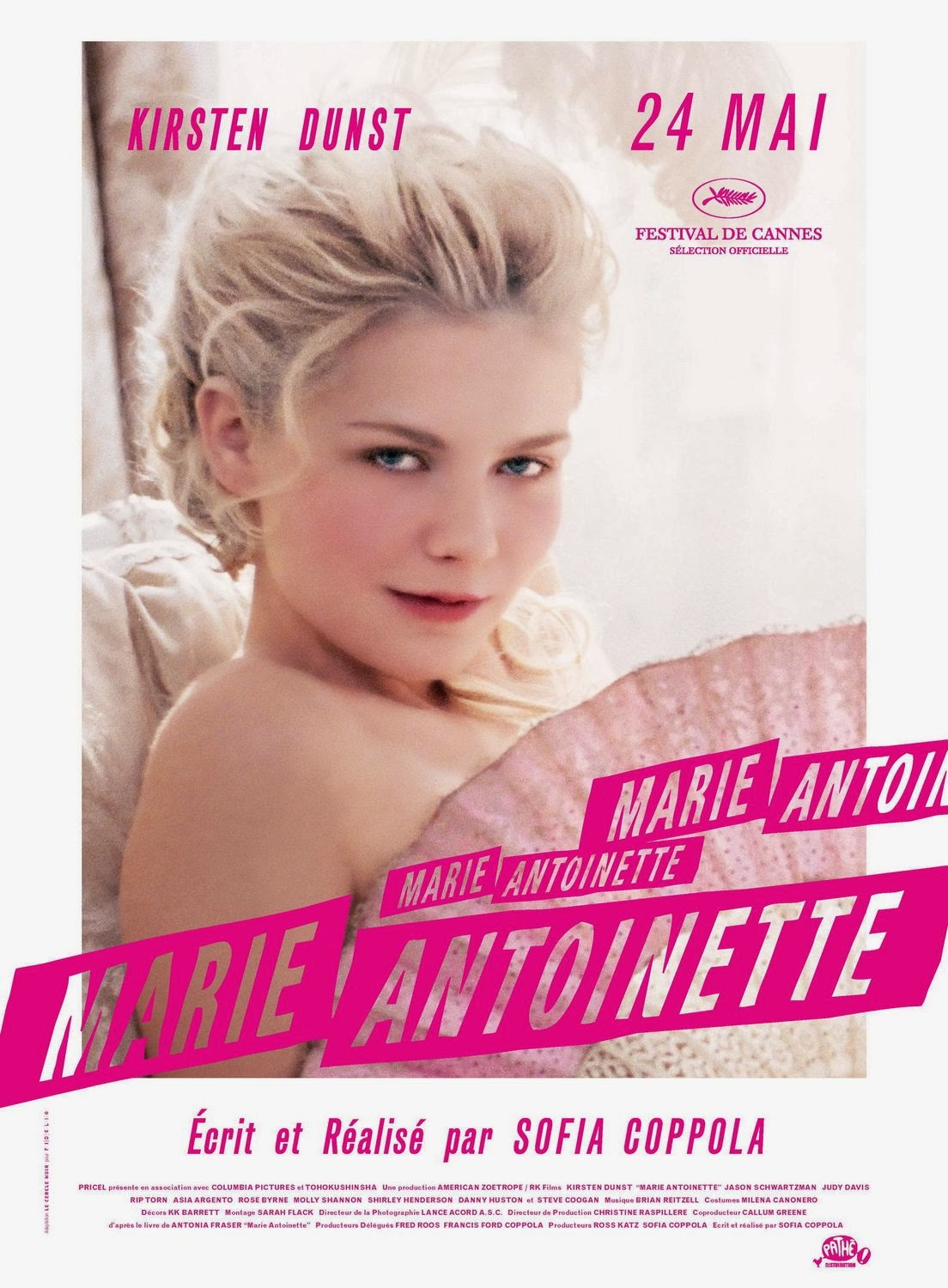
026. Marie Antoinette (United States and France - 2006)


A lavish production with empty premises. Sure, the parodic way Sofia Coppola found to depict the historical figure of Marie Antoinette can be a bit interesting, but that's as far as it goes. A bit interesting. The film contains beautiful images, both of scenery and of costumes/make-up/setting, but the dialogues are completely out of place. It seemed as though Sofia hadn't made up her mind about whether she wanted a historical film or a temporal adaptation, bringing the thematic nuances of the production to today's fads and language, as well as music. But it was a failure. Empty dialogues, messed up dramas and conflicts, and a disservice as regards social conscience: the working classes are seriously taken as a rather dull hindrance to the queen's luxury, while she celebrates her own futile events and indifference to her people. And there's no resolution that justifies that in the end. The subjective figure of Marie keeps on going as materialistic as possible.
What a lousy job, Sofia...

Director: Sofia Coppola.

Score
Cinematography: 7.5
Acting: 7.0
Editing: 6.0
Sound: 6.0
Text: 5.0
Concept: 6.0
Premise execution: 4.5

Average Score: 5.9

025. The Shining (International Co-production - 1980)


This is one of the films I felt ashamed of never having watched before. We watched it on Sunday, and it was a curious experience. I expected more, having heard previously about the innovations it brought to the field of suspense/horror films. I didn't see much, to be honest. What I saw was a great acting by Jack Nicholson, and some nice props and brilliant editing and photography. That I already expected from Kubrick. But the annoying soundtrack - although it's highly atmospheric and composed to provide a purposefully bothersome sensation, it's way too loud for my ears to balance it with the images and text; it becomes a sensorial mess - and the predictable suspense disappointed me. I didn't see anything that special. It is, by far, the "least good" Kubrick film I've watched so far. Considering Clockwork Orange, Dr. Strangelove, Barry Lydon and the two short documentaries. I know, there's more to come.

Director: Stanley Kubrick.

Score
Cinematography: 9.0
Acting: 8.5
Editing: 9.0
Sound: 6.5
Text: 8.0
Concept: 7.0
Premise execution: 7.5

Average Score:
7.9

Wednesday, 5 February 2014

021. Flying Padre (United States - 1951)


Kubrick's second short-film was a bit more liturgic and mournful; yet one can already see the striking features of a filmic visionary. He directs and writes for the production. Bird's-eye shots of gorgeous landscapes that impress when considering the simplicity of such a short film, and the clean voice-over narration, so pleasant to the ears as it carries that typical tone of 50s cinema with it. Not to mention the smart sound mixing. It's a story of two ritualistic days in the life of a priest in New Mexico, yet portraying a certain impartial - and merely documental - perspective on religion. It was a portrait of a man's duties, religious or otherwise.

It is interesting to note how Kubrick, being so talented, started with such unpretentious projects for films. Both this and Day of the Fight show the rudimentary Stanley in action, already showcasing his talents as a filmmaker and as a writer. Well-organised plotline and polished text. Too bad it was too short and simple to gather much of his talent.

Director: Stanley Kubrick

Score
Cinematography: 8.5
Acting: 5.0
Editing: 8.0
Sound: 7.0
Text: 7.0

Average Score: 7.1

020. Day of the Fight (United States - 1951)


The first of many Kubrick's films to come on this list. And this is, in fact, his first film. It impressed me in terms of cinematography - the framing was close to perfection -, cuts and the pace of the narration. A documentary-like short film depicting the moments before a fight of a boxer (Walter Cartier, as himself) who has to go through physical constraints to have a good performance not only in his bout, but also in the weighing before it. Nice portrayal of the hard boxing life several fighters had to endure back in the first and early second half of the 20th century.

Director: Stanley Kubrick.

Score
Cinematography: 9.0

Acting: 6.0
Editing: 8.5
Sound: 7.0
Text: 8.0

Average Score: 7.7

Tuesday, 4 February 2014

018. Running with Scissors (United States - 2006)


Confusing linearity, but that's the good thing about this film. The performances are good enough for the purpose of the storytelling, and well balanced with the use of progressive disintegration of the characters' subjectivity. Everyone here dies away quickly, from Deirdre and Norman (the parents) to Dr. Finch (the weird and apparently cunning shrink with an ego that flies about with excessive pride). Everyone but Augusten. He is caught up in the middle of bad business in his family, where both parents want to impose their own honour, causing detriment to the son's welfare (a reality in many families that we all know). Augusten proves to have a strong sense of individuality, which he may well have inherited from any of his parents, and walks away with his supposed dignity, free from the chains of tutelage, either from the selfish Deirdre or from the delusional Finch. Good film, although redundant with the use of montage and long, unnecessary sequences of drama-driven dances.

On the other hand, superb performance by Annette Bening.


Director: Ryan Murphy

Score
Cinematography: 7.5
Acting: 8.5
Editing: 7.0
Sound: 7.0
Text: 8.5


Average Score: 7.7


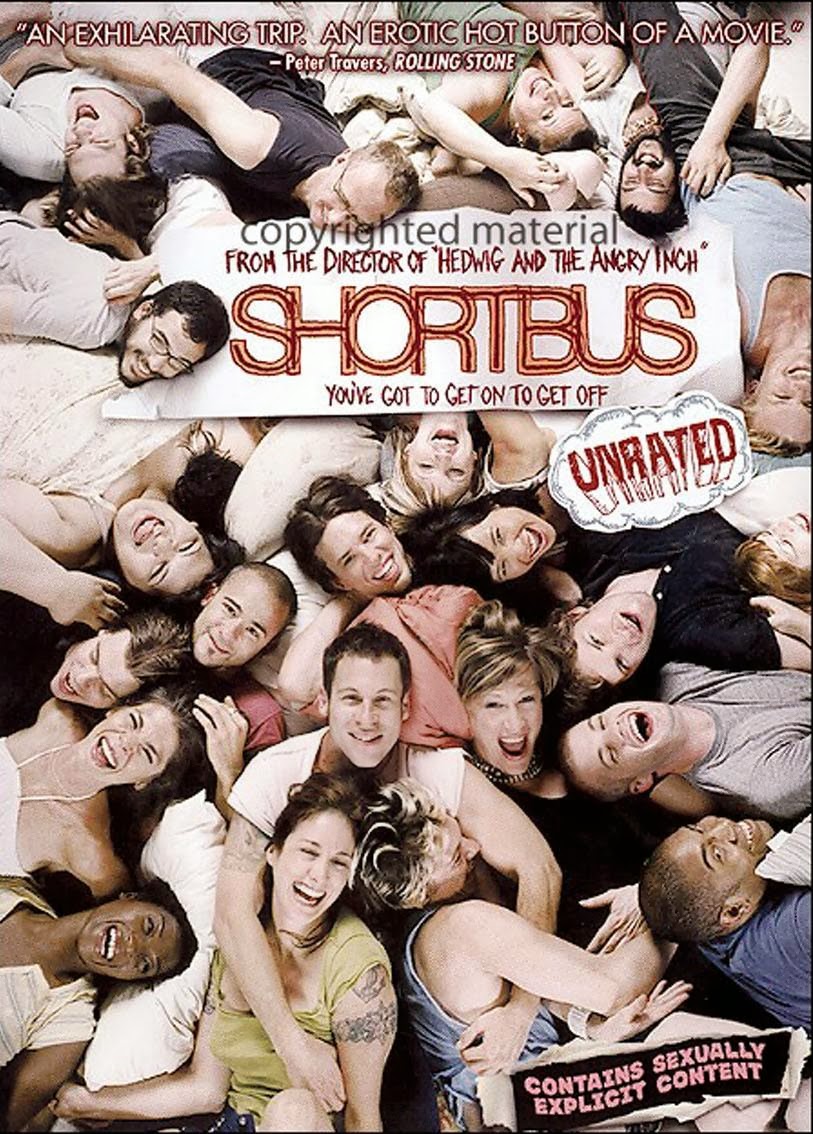
016. Shortbus (United States - 2006)


A very hard film to digest, at least for me. It's not the explicit footages of sex, it's the frequent use of them. Explicit sexuality will still be, for many people, a taboo for years to come. I don't agree with that; it's fine, really. A film in which the central topic is sexuality may very well make use of sexual audiovisual motifs; it must, even. Shortbus doesn't shock one with its carnal images as much as it shocks one with the internal conflicts, though. The characters are flawed, or better yet, carry out flawed sexual lives in deep frustration, and there are beautiful moments of joy and freedom for each one of them in their own universe of dilemmas. The problem here is absolutely personal. My sensorial apparatus is not always ready for such a strong load of instinctual narrative.

Director: John Cameron Mitchell.

Score
Cinematography: 8.0

Acting: 9.0
Editing (a confusing one, by the way): 6.5
Sound (very polluted passages quite often): 6.0
Text: 8.0

Average Score: 7.5

014. Hesher (United States - 2011)


Another American film that me and Jéssica watched last week. Pretty decent one. Story of a father and kid who have to go through the pain and suffering of losing a mother/wife to a car accident, and still have to cope with the presence of a rather bizarre individual that emanates anger and indifference (excellently played by Joseph Gordon-Levitt). Hesher shows us an interesting way of constructing a peculiar character: Hesher is the façade that expresses T. J.'s hate for losing his mother, a mirror through which the little lad sees himself and which he uses to give vent to anger. A bothersome challenge that defies the senses of order and convention. No boundaries for Hesher, and for Gordon-Levitt's performance.
Only the occasional soundtrack by Metallica sounds a bit cheesy and out of place sometimes. That put me off during some moments of the film's experience.

Director: Spencer Susser.

ScoreCinematography: 7.5

Acting: 8.5
Editing: 7.0
Sound: 7.0
Text: 7.5

Average Score: 7.5

Monday, 3 February 2014

013. Top Secret! (United States - 1984)


(Finally back after several days of hiatus; the next five or so films were watched about one week ago)

A wave of good and bad. Mostly bad.
Val Kilmer is decent in this film, especially seeing as how comedy isn't his forte, he carries on a consistent character and seldom fails in his performance. And it all begins well, with nice parodies of spy movies in the 50s and 60s, and with reference to American stardom of the same era. This is the same style as Airplane!; actually, made by the same director, Jim Abrahams; so you can't expect much, since the options for comedic passages in such films quickly vanished in the very 80s that begot them. As the film progresses, it just gets bad and with silly mistakes of continuity. It just gets old quickly.

Director: Jim Abrahams

Score
Cinematography: 7.5

Acting: 7.0
Editing: 6.0
Sound: 6.5
Text: 6.0

Average Score: 6.6

Tuesday, 21 January 2014

010. Precious (United States - 2009)


"In New York City's Harlem circa 1987, an overweight, abused, illiterate teen who is pregnant with her second child is invited to enroll in an alternative school in hopes that her life can head in a new direction." I found this summary on IMDb, and there's no better way to sum up what Precious is in a few words. A stunning dramatic experience, the struggles of a bottom-of-the-social-beauty-patterns girl (played by Gabourey Sibide) who also lives with the disgrace of a neglectful and selfish mother and the burden of early-age pregnancy caused by being raped by her own father. It's hard to present a worse urban background than that. The film surprises in that it does not seek to show a happy ending, but to affect the viewer's notion of comfort and adversity. I was deeply sunk into a sea of a sincere portray of an extremely indigent and violent family nucleus in the worst-case scenario of living in Harlem, NYC. Precious can shock for good.

Director: Lee Daniels.

Score:
Cinematography: 8.5
Acting: 9.0
Editing: 8.0
Sound: 7.5
Text: 8.5

Average score: 8.3

009. I'm not there (United States - 2007)


On Saturday, while at my cousin Fellype's house, I watched I'm not there. Now, that's a unique experience in itself, a film that disembowels the most abstract aspects of Bob Dylan's career, sorting out all his memorable moments in life in six different personas throughout the film (played by Ben Whishaw, Marcus Carl Franklin, Christian Bale, Heath Ledger, Cate Blanchett and Richard Gere, in order of appearance). I never expected to watch a biographical film like that. However, I'm not sure I grabbed every meaningful instance the film had to offer, so I finished it quite confused. I was certain that it had been a great cinematographically sensorial experience, but had little to comment on for my knowledge on Dylan's life is very short. Only the temporal and graphical continuation can be deceiving sometimes, and to me, that was a big con for I'm not there. Besides, the long length of it can wear one out, but just if you're not delved into the magnificent photography and the emblematic dialogues. Great film.

Director: Todd Haynes.

Score
Cinematography: 9.0
Acting: 9.0
Editing: 6.5
Sound: 8.5
Text (amazing one, but considering the viewer has got a previous - and wide - knowledge on Dylan's life) : 8.0

Average score: 8.4

Monday, 20 January 2014

007. Fargo (United States - 1996)


"A homespun murder story." Nice little film. It portrays a bizarre plot of a fictional series of murders that the Coen brothers pulled out of different real-life incidents in 1987 in North Dakota and Minnesota. A husband that is greedy enough to plan a fake kidnapping of his wife by hiring two bandits who ultimately destroy his life by killing his wealthy father-in-law, a policeman, two citizens and his wife (sorry for the spoiler, lads and lasses). The drama is full of Midwest hillbilly-themed humour and odd elements of detective narrative (the actress Frances McDormand plays a light-spirited police officer who's in charge of the investigation, and yanked an Oscar for Best Actress out of it). Good one for the Coen bros. I liked it quite a lot.

Director: Joel Coen.

Score
Cinematography: 8.0
Acting: 8.5
Editing: 8.0
Sound: 7.5
Text: 8.5

Average Score: 8.1

Saturday, 18 January 2014

006. Black Swan (United States - 2011)


A succession of dramas in the life of a compulsively perfectionist ballerina. Nina lives the dream of being the Swan Queen of the famous Tchaikovskiy's ballet piece, and the road to it is hurtful, full of identity and sexual conflicts. Aronofsky directs a beautiful filmic fiction on the White Swan/Black Swan duality of the piece, and proposes the artist's perspective on the theme (in this case, the ballerina's). The sensorial doubt between reality and Nina's deliria is sometimes bothersome, but I found it to be part of the film's cathartic process. Black Swan, with the geniuses of acting such as Portman and Cassel, and a compelling narrative, is a wonderful film.

Director: Darren Aronofsky.

Score
Cinematography: 8.5
Acting: 9.0
Editing: 8.5
Sound: 8.5
Text: 9.0

Average score:
8.7

Wednesday, 15 January 2014

005. Welcome to the Dollhouse (United States - 1995)


Now this is an odd one. The protagonist, with whom we sympathise and whom we hate at the same time, suffers from bullying at school and bullies at home, as a way of externalising her frustrations and at once feel like a real person after the humiliations from her classmates. A film of American monsters from the 90s, and satirising the teenage film culture of the 80s/90s, Welcome to the Dollhouse surprised me with its concept, despite its all too trivial dialogue, generally bad acting, and sometimes confusing graphical shot relation.


Director: Todd Solondz.

Score
Cinematography: 7.0
Acting: 6.0
Editing: 5.5
Sound: 5.5
Text: 6.0

Average score: 6.0